

Expanding support for people living with aphasia
For people living with aphasia, a communication disorder that can affect speech and language, staying connected after hospital care can be one of the biggest challenges. Addressing this gap is a priority for Hearing & Speech Nova Scotia (HSNS).
First introduced through the HSNS Innovations Fund, the Life After Stroke project was designed to support people with communication challenges during the often-isolating period between hospital discharge and outpatient services. Over the past year, that idea has grown into the newly named Aphasia Innovation Project.
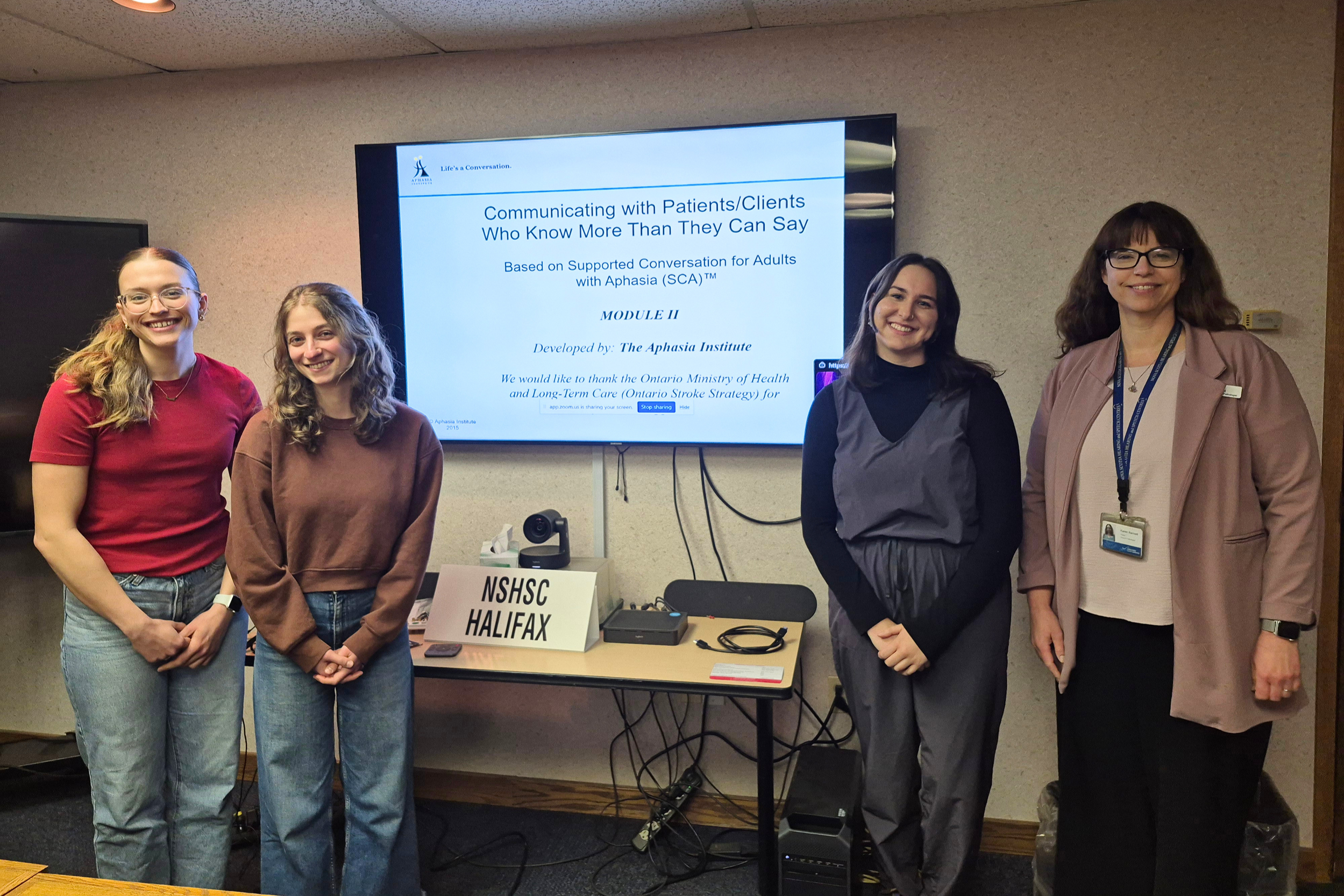
Left to right: Paige Lauwerijssen, Isabel Aboud, Stacie Ranta-Diegel, and Karen Barnett from HSNS.
Through the fall and winter, the focus was on building a strong foundation. Speech-Language Pathologist Molly Young worked closely with HSNS clinicians and teams across the organization to design the program, develop volunteer processes, and plan how success will be measured.
First brought forward by Patient Advisor Ferne Mardlin-Smith, the project continues to be guided by her lived experience through her ongoing involvement.
One of the biggest areas of progress has been volunteer recruitment. Interest has been strong, with Dalhousie University School of Communication Sciences and Disorders students and experienced professionals stepping forward to get involved. Many are now completing onboarding and training, including learning how to support communication using approaches developed by the Aphasia Institute.
As the project took shape, its reach expanded. It will now support people with aphasia from a range of causes, not just stroke, and will include virtual options to better serve people in rural and remote communities.
When it launches, the project will offer weekly communication groups, one-on-one client support, and education for both clients and communication partners. Together, these services are designed to reduce barriers, create connection, and improve equitable access to care across the province.
With volunteers nearing the end of their training, the project is ready to begin—an exciting next step in bringing a thoughtful, community-informed model of care to people who need it most.